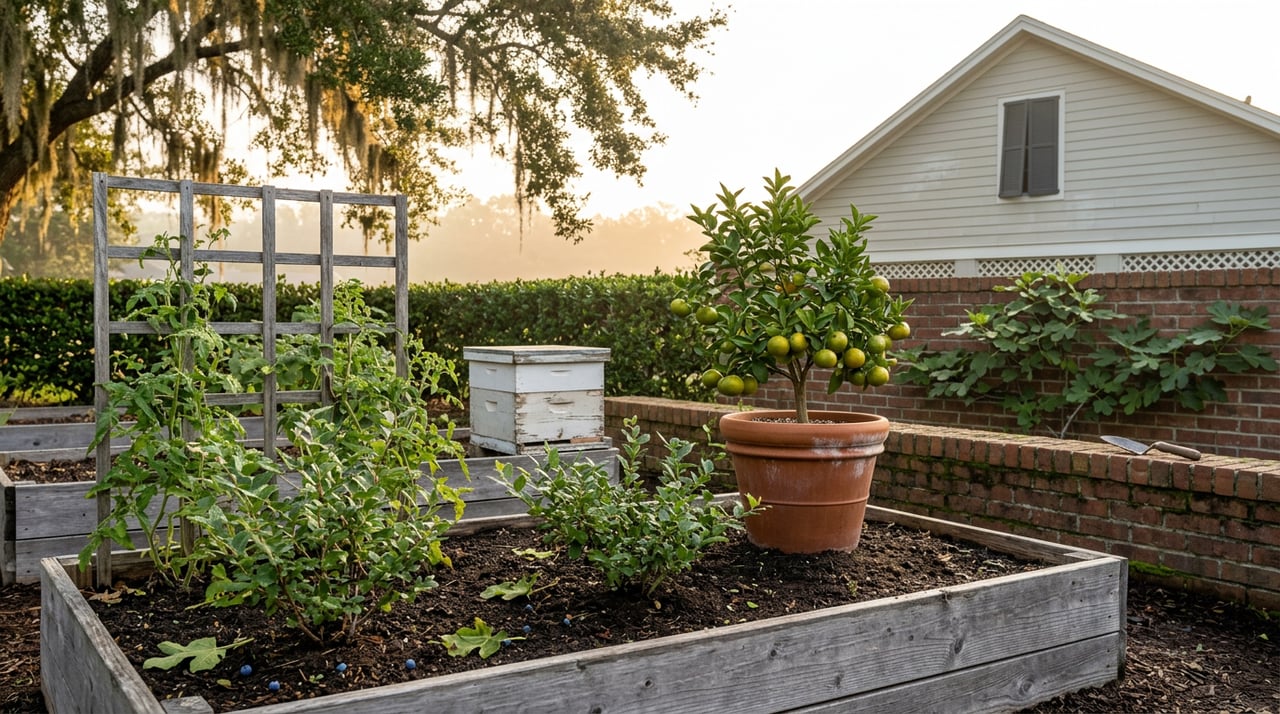
What actually happens behind the fence near the POA service offices, the one most residents drive past on the way to Spring Lake without a second glance?
Most people who live inside Hilton Head Plantation could tell you where the marina is, which golf course has the water views, and when the pool at Spring Lake gets crowded. Fewer could tell you that the fenced quarter-acre tract near the service offices runs its own calendar entirely, disconnected from the golf tee sheet, the marina slip waitlist, or anything else on the plantation's official amenity map. It has 300 members. It skips exactly three months a year. And its next scheduled gathering is four days away.
That tract is Seabrook Farm, home to the HHP Farmers' Club, and it is worth understanding on its own terms rather than as a footnote in the neighborhood's amenity list.
More Members Than Plots
The math here doesn't quite add up, and that's the first thing worth noticing. The Farmers' Club has approximately 300 members. The fenced growing area holds 216 individual plots, each 25 feet by 25 feet. That's not a rounding error. Somewhere in that gap is a real answer about how many households share a plot, how many join for the dinners and workshops without ever touching a plot themselves, and how much interest a patch of dirt inside a plantation known for golf and deepwater docks can generate.
Whatever the exact breakdown, the plots themselves are working hard. Members grow eight kinds of citrus, along with blueberries, figs, apples, peaches, and pecans on their individual squares. Separate from the personal plots, the club maintains common plots planted specifically to stock the farmers market: onions, potatoes, beans, corn, squash, and flowers. There are bee hives on site as well, which matters more than it sounds like it should. Citrus and stone fruit need pollinators, and a community garden that keeps its own hives is a community garden that's planning for output, not just hobby gardening.
The Farm's Own Calendar
Compare Seabrook Farm's operating rhythm to the plantation's better-known amenities and the difference is immediate. Golf tee times run year-round. The marina doesn't close for the season. The Farmers' Club does both, on purpose.
| Activity | When it happens | When it doesn't |
|---|---|---|
| Monthly dinner meetings | First Thursday, Plantation House | Skips January, July, August |
| Summer produce market | Saturdays in May, June, July | Closed rest of year |
| Winter produce market | Saturdays in November, December | Closed rest of year |
| Fall hayride | Sometime in autumn, POA-hosted | N/A |
The club's confirmed 2026 dinner dates ran February 5, March 5, April 2, May 7, and June 4, then went dark for the summer. The next one is scheduled for September 3, which as of this writing is four days out. October 1 follows, then a November date to close the year. Nine dinners total, each held at the Plantation House, each preceded by an email notification roughly two weeks out and a required RSVP, since seating is limited.
The pattern is worth sitting with. January is a slow month for a lot of Lowcountry life, so skipping it tracks. But July and August are peak tourist season on Hilton Head Island, the months when the beaches and restaurants are busiest. That's precisely when the club goes quiet. Whatever else is true about how full-time HHP residents structure their year, the farm club's calendar suggests the club's working season and the island's tourist season don't overlap much at all.
What's Actually for Sale, and When
If you've been meaning to check out the farmers market this year, the timing already slipped past. The summer market ran its Saturdays in May, June, and July, and that window is closed. The next chance is the winter market, Saturdays in November and December, when the common plots come back into production and the club opens the gates to sell what they've grown. Mark the calendar now rather than finding out in October that you missed it again.
The Hayride Nobody Advertises
Sometime after the summer break ends, the POA hosts a fall hayride through the farm itself, with kids in costume riding hay wagons while club members walk alongside explaining what's growing in each row. It's a small event by plantation standards, no ticketed entry, no citywide promotion, just a neighborhood tradition tied to a working garden rather than a clubhouse. It doesn't show up on any list of Hilton Head Island events because it isn't built for visitors. It's built for the roughly 10,000 residents behind HHP's gates, most of whom have never heard of it either.
Back Porch Seminars and the Dinner That Isn't About Farming
The club also runs periodic "Back Porch Seminars," informal sessions where members trade what they know about planting and cultivating fruits, vegetables, and flowers. These aren't scheduled with the same regularity as the dinners, more of an as-needed exchange of knowledge than a formal class series, which fits a club that seems to run on relationships as much as on harvest yields.
That's really what the nine annual dinners are for. A potluck at the Plantation House isn't primarily a farming event. It's a reason for 300 people who share a hobby and a fence line to sit down together nine times a year, in a plantation large enough that neighbors on opposite sides of it might otherwise never cross paths. The garden gives them a reason to grow something. The dinner gives them a reason to show up even in months when nothing needs weeding.
A Different Model Down the Road
Hilton Head Plantation isn't the only community on the island with this kind of setup, and the comparison is useful context. Sea Pines runs its own version, the Heritage Farm, sited next to the Forest Preserve on land that supports roughly 53 rentable plots, with a portion of that ground set aside every season for charitable crops that get donated to organizations like Deep Well and Second Helpings. Their signature planting is Vidalia onions, a tradition kept up every season since the farm began.
The scale is different. HHP's club runs at roughly four times the plot count with a membership drawing from a much larger, more spread-out community. But the instinct is the same on both ends of the island: give residents a working patch of ground, and something closer to an actual neighborhood forms around it than a shared pool ever manages to produce.
Why This Corner Matters More Than It Looks
None of this shows up on a plantation map or a POA amenity brochure in the way the golf courses and marina do. There's no membership fee comparison chart, no ranking against other Lowcountry gated communities. What Seabrook Farm offers instead is a look at how a slice of Hilton Head Plantation actually organizes its year, on a calendar that has nothing to do with tee times or boat slips and everything to do with citrus ripening, potluck RSVPs, and a hayride that only the people who live there ever hear about.
If you're already behind the gates, the next dinner is September 3. If you've never walked past the fence near the service offices, this fall's hayride is as good a reason as any to finally find out what's growing back there.
For more on what makes daily life inside Hilton Head Plantation worth paying attention to, from the marina to the trails to the neighborhoods tucked between them, reach out to Tierra Schaffer. Let's Connect.